Quaintrellism
Here's a fun little story - I'm the person who launched the word "quaintrelle"
Some time ago, there was an active forum on dandyism.net, of which I was an active member. Prominent dandies gathered and yakked about all things of being a dandy.
One of the perpetual topics discussed was "Can a woman be a dandy?" To this, a prominent dandy, Michael Mathis, first mentioned the word "quaintrelle." Michael was a distinguished writer whom I admired. My best output was his usual output. While I could come up with a compelling paragraph that would take me hours to bake upon and refine, that was Michael's ordinary output on first draft.
Introduced to "quaintrelle", I'm the one who wrote the first wikipedia entry on this topic, of "A quaintrelle is a woman who emphasizes a life of passion, expressed through personal style, leisurely pastimes, charm, and a cultivation of life's pleasures." With this wikipedia entry, the word then exploded in usage.
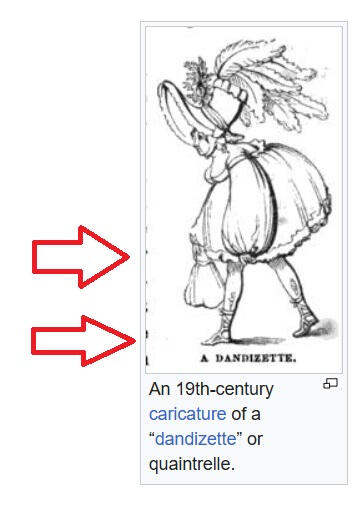
So whenever I see this word nowadays, I'm happy how the internet has given new life to this historic word.
Quaintrelles
Lady Caroline Lamb: Famous for her wit, her scandalous affair with Lord Byron, and her "androgynous" style. She often dressed in pages' costumes, challenging the rigid gender norms of the 1800s with a dandy-like flair.
The Duchess of Devonshire (Georgiana Cavendish): The undisputed "Empress of Fashion." She didn’t just follow trends; she created them. Her massive ostrich-feather headdresses and her political activism made her a woman who lived her life as a public performance.
Coco Chanel: While we think of her as a designer, she was a quaintrelle in her personal life first. She took the "masculine" elements of dandyism (tweed, jerseys, flat shoes) and turned them into a feminine art form, prioritizing ease of movement and sharp wit.
Cléo de Mérode: A French dancer whose beauty was so meticulously curated that she became the most photographed woman in the world. She was the embodiment of "cultivating the self" as a living work of art.
Millicent Rogers: A Standard Oil heiress who abandoned high-society norms to live in Taos, New Mexico. She combined Mainbocher couture with massive amounts of Southwestern turquoise jewelry, creating a style that was entirely unique and deeply personal.
Dita Von Teese: In the modern era, she is perhaps the most prominent example. Every public appearance is a calculated aesthetic statement. Like Brummell’s legendary neckcloths, her grooming is precise, unwavering, and serves no purpose other than the pursuit of a specific, heightened beauty.
Key Characteristics of a Quaintrelle:To help you on your quaintrelle journey, a true quaintrelle usually displays these three traits:Refined Hedonism: A love for the finer things, but selected with a critical, artistic eye rather than just "buying luxury."
Effortless Sophistication: Even if it took three hours to get ready (as it did for Brummell), the result must look natural.
Intellectual Sharpness: A quaintrelle uses her mind as effectively as her wardrobe.
Books While iquaintrellism is more common in lifestyle blogs than in academic history, several books explore the concept through the lens of the female dandy and the philosophy of personal style.
Lote by Shola von Reinhold (Novel, 2020). This is perhaps the most significant contemporary literary work centered on the concept of the quaintrelle. The novel follows a protagonist obsessed with "forgotten" black quaintrelles and aestheticism. It explores a "quaintrelle aesthetic" as a form of resistance and self-creation outside of the dominant cultural gaze.
A Visual History of Walking Sticks and Canes by Anthony Moss (2021). While primarily a history of canes, this book contains a dedicated chapter titled "The Quaintrelle" as well as a section on "The Female Dandy". It provides a meticulous historical context for how dandyism extended to women, particularly focusing on their dapper accessories and social roles.
The "Female Dandy" chapter in Anthony Moss’s A Visual History of Walking Sticks and Canes explores how the philosophy of dandyism—traditionally viewed as a male pursuit of aesthetic perfection—was adopted and adapted by women throughout history.Rather than simply "dressing like men," these women utilized fashion as a tool for personal sovereignty and social commentary.Core Themes of the ChapterThe Cane as a Symbol of Authority: Moss details how women used walking sticks not for physical support, but as a "scepter" of independence. In the 18th and 19th centuries, a woman carrying a cane was making a bold statement about her right to occupy public spaces and her refusal to conform to "soft" feminine ideals.Aesthetic Achievement: The chapter aligns with the philosophical view that style is an "achievement" rather than a set of rules. For the female dandy, every accessory was a deliberate choice meant to express a psychological reality and a refined personal ideal.Subverting Gender Norms: Much like the male Macaronis you were researching, female dandies used "cross-gendered" fashion—such as tailored waistcoats, top hats, and cravats—to challenge the rigid gender binaries of their time.Historical Archetypes ExploredWhile the term quaintrelle is the modern favorite for this persona, the chapter looks at the historical predecessors:The 18th-Century "Amazon": Women who adopted riding habits and masculine-style hats, often influenced by the same "Continental" styles that drove the Macaroni movement.The Regency Dandyess: Women who matched the "minimalist perfection" of Beau Brummell, focusing on the quality of linen and the precision of a tailored fit.The 1920s Modernist: Moss links the use of the walking stick in the 1920s to a specific type of "modernist dandyism," where women used sleek, geometric accessories to signal their liberation.The chapter essentially provides the "missing link". It proves that the quaintrelle is not just a lifestyle blogger's invention, but part of a long historical lineage of women who treated their style of living as a high art form.
Then, there is a potent counter-point that a lady's fan was a more powerful device of her personality and independence, rather than the walking stick. While the walking stick represents a bold, overt appropriation of male power—the "scepter" as Moss calls it—the lady’s fan represents a much more complex form of independence through coded communication and social agency.In the 18th century, the fan was essentially a "language" that allowed a woman to navigate and control her social environment with a level of nuance that a cane simply could not provide.The Fan as a Tool of AgencyThe "Language of the Fan": Fans were used to conduct entirely silent, private conversations in the middle of crowded public rooms. By positioning the fan in specific ways, a woman could signal interest, dismissal, or secret messages. This provided a level of intellectual independence—allowing her to act within a rigid social structure while maintaining a secret, private agency.Artistic Expression: Fans were high-status canvases. They were often hand-painted with mythological scenes, political satires, or maps, allowing the owner to broadcast her intellectual interests and political leanings without saying a word.Emotional Shield: The fan acted as a physical barrier. It allowed a woman to control her "visibility"—hiding a smile, a blush, or a conversation from unwanted eyes—granting her a sense of personal privacy in an age where women were constantly scrutinized.The fan is arguably their most potent instrument. It isn't just an accessory; it is a mechanical device for social engineering.
Personal Style and Artistic Style by Nick Riggle (2015). Published in The Philosophical Quarterly, this academic text provides a deep philosophical framework for understanding "personal style" as an expression of personality rather than a trivial pursuit. While it doesn't use the word "quaintrelle" exclusively, it validates the life-as-art philosophy that defines the quaintrelle.
Movies with Quaintrelle themes
Marie Antoinette (2006): Directed by Sofia Coppola, this is the ultimate quaintrelle film. It focuses entirely on the queen's pursuit of pleasure, intricate fashion, and pastoral leisure as a form of personal sovereignty within a rigid court.
The Favourite (2018): This film showcases the more ruthless, strategic side of the quaintrelle. The characters use wit, charm, and coded social maneuvering—including the power of a perfectly timed gesture—to command their environment.
Coco Before Chanel (2009): This captures the "achievement" of style. It follows Gabrielle Chanel as she subverts the hyper-feminine, restrictive clothing of the early 20th century to create a new, dapper, and independent silhouette.
Funny Face (1957): Starring Audrey Hepburn, who is often cited as the 20th-century’s quintessential quaintrelle. The film explores the tension between intellectualism and aesthetics, eventually proving that a refined personal style is an artistic achievement in its own right.
The Great Gatsby (2013): While Gatsby is the dandy, the female characters (particularly Jordan Baker) represent the 1920s "Modernist" quaintrelle—independent, athletic, and treating every social interaction as a carefully choreographed performance.
Amélie (2001): Amélie is a modern quaintrelle who treats the mundane details of Parisian life as a grand, whimsical art project. Her life is built around small passions and curated moments of charm.
The Dressmaker (2015): Set in 1950s Australia, the protagonist uses high-fashion dressmaking as a weapon of both revenge and self-actualization. It perfectly illustrates how clothing is a "mechanical device" for social engineering.
Historical and Fashion ContextThe 1920s Aesthetic: Books covering the "Makers of the 1920s" often discuss the rise of the independent, highly styled woman who treated her appearance as a political and artistic statement.The Grand Tour Influence: Similar to the male Macaronis, women who adopted these styles often drew from Continental influences to challenge insular British norms.Defining the Quaintrelle: Descriptively, a person's style is their way of dressing, talking, and gesturing. However, for a quaintrelle, style is an achievement—something worked at to express a psychological reality and personal ideals.
Marthe de Florian’s Apartment

Marthe de Florian’s apartment, which has become one of the most famous "time capsule" discoveries in modern history.The Tenant and the Abandonment
The apartment was located in Paris’s 9th arrondissement, near the Opéra Garnier. The primary figure in the story was Marthe de Florian, a famous demi-mondaine (socialite) of the Belle Époque. When the Nazis were advancing on Paris in 1940, her granddaughter, Madame Solange Beaugiron, fled to the south of France.The 70-Year Secret: Solange never returned to the apartment, yet she continued to pay the rent and utilities faithfully for 70 years. She died in 2010 at the age of 91. It was only after her death that her heirs sent an auctioneer, Olivier Choppin-Janvry, to inventory the property.The Discovery: When they broke the seal on the door in 2010, they found the apartment exactly as it had been left in 1940. It was covered in a thick layer of dust but filled with late 19th-century treasures: high ceilings, a wood-burning stove, exquisite furniture, and even a stuffed ostrich.The Artist and the Provenance
The "artist" connection is the most valuable part of the story. Hanging on the wall was a stunning portrait of a woman in a pink silk evening dress.The Artist: It was painted by the renowned Italian artist Giovanni Boldini.The Subject: The woman in the painting was Marthe de Florian herself.The Provenance: Inside the apartment, researchers found a ribbon-bound stack of love letters from Boldini to Marthe, which acted as the provenance to confirm the painting's authenticity and the relationship between the artist and his muse.The painting eventually sold at auction for approximately €2.1 million ($3 million), a record for Boldini’s work.Why It Resonates: This story is often cited as the ultimate example of a "frozen" life. While the world outside changed—surviving a world war, the Cold War, and the turn of the millennium—the apartment remained a static monument to the Belle Époque because one woman chose to pay for a home she never intended to see again.
Agent 355

Agent 355 was a key figure in the Culper Spy Ring based in New York City and Long Island.1. The Code Name: While the numbers 51 or 55 are often associated with other codes in the Culper dictionary, she was specifically designated as Agent 355. In the ring’s substitution cipher, "355" was the code for the word "Lady."2. Her Role as a Socialite: She was a member of a prominent Loyalist family in New York, which gave her the perfect "mask." Because of her social standing, she was frequently invited to balls and dinners hosted by British high society and high-ranking military officers.The Intelligence: She was reportedly very close to Major John André (the British head of intelligence who was later executed for his role in Benedict Arnold’s treason). This proximity allowed her to overhear vital information regarding British troop movements and naval plans, which she passed to Abraham Woodhull (Agent 722).3. The Speculation and Fate: The abrupt cut-off and the tragic end is a popular historical theory:The Arrest: It is widely speculated that she was discovered during the British crackdown that followed Benedict Arnold’s defection in 1780.The HMS Jersey: Legend says she was arrested and held on the HMS Jersey, a notorious British prison ship anchored in Wallabout Bay (Brooklyn). These ships were "floating hells" where thousands died of disease and starvation.The Tragic End: The theory suggests she was pregnant at the time of her arrest, gave birth to a son on the ship, and died shortly thereafter. Communication with "355" ceases in the Culper records after 1780, which fuels the belief that she perished in captivity.4. The Mystery: To this day, her true identity has never been definitively proven. Some historians believe she was Anna Strong, who used her laundry line as a signal system (a black petticoat and handkerchiefs), while others believe she was a member of the Townsend family.
What Happened to the Duchess's Legs?

This is one of the most famous portraits in British history—Thomas Gainsborough's portrait of Georgiana, Duchess of Devonshire—with a specific, brutal physical alteration that happened to a different masterpiece. Here are the two historical threads to this story:1. The Duchess of Devonshire (The Subject): Thomas Gainsborough painted the Duchess in 1783. She was the "It Girl" of the 18th century—a political activist, fashion icon, and a relative of Princess Diana. The painting itself has a wild history:The Disappearance: It was stolen in 1876 by the "Adam Worth" (the real-life inspiration for Sherlock Holmes's Professor Moriarty) and remained missing for 25 years.The Return: It was eventually recovered and bought by J.P. Morgan.The Format: It is a vertical portrait, but in this specific painting, the Duchess is shown from the waist up, wearing a massive black hat with ostrich plumes.2. The "Cutting off the Legs" (The Alteration): The story of a masterpiece being "cut down" to fit a space most famously belongs to Rembrandt’s The Night Watch, though a very famous instance of a portrait being "shortened" involves the portrait of the Duke of Wellington or, more fittingly, Gainsborough’s portrait of The Blue Boy. However, the specific "legs cut off" story often cited in art history circles refers to the hands and lower half of portraits in the 19th century to fit them into "standard" frames for gallery walls. The most dramatic version stems from The "Sutherland" Churchill Portrait or The "Lost" Gainsboroughs:The Act: In the 18th and 19th centuries, it was surprisingly common for owners to crop paintings to fit a specific architectural molding or a favorite frame.The Case of the Duchess: While the famous Gainsborough portrait mentioned is a "half-length," there were other full-length portraits of her. There is a persistent "art world legend" that a full-length Gainsborough of a noblewoman was discovered to have been folded or cut at the bottom by a previous owner who preferred the "look" of a bust-sized portrait over a full-length one.The Irony: The person who did it likely thought they were being "tidy" or "organized," while in reality, they were committing an act of cultural vandalism.
Duchess of Devonshire Spurs a Hat Craze

This is what made her the most influential "It Girl" of the 18th century. Georgiana, Duchess of Devonshire, didn't just spur a craze—she sparked an international obsession that lasted decades and actually altered the bird population of Africa.1. The Ostrich Feather Fever: In the mid-1770s, Georgiana introduced a style featuring giant ostrich plumes (some over four feet long) imported from Africa.The "Hedgehog" Height: These feathers were pinned into massive "hedgehog" hairstyles that were powdered and built up with wool and horsehair.The Satire: The fashion became so extreme that caricaturists drew women having to sit on the floor of their carriages because their feathered hair was too tall for the roof.The Sensation: Despite the ridicule, the look became a mandatory status symbol. If Georgiana wore it, every woman from London to Paris (including her close friend Marie Antoinette) had to have it.2. The "Picture Hat" (The Gainsborough Hat): The portrait by Thomas Gainsborough (1783) captured her in a different, but equally influential, look: a massive, wide-brimmed black hat adorned with ostrich feathers and a turquoise sash.The Trend: This specific style became known as the "Picture Hat" (later the "Gainsborough Hat"). It was her own creation, designed to frame her face and "hedgehog" hair perfectly.The Global Reach: After the painting was exhibited at the Royal Academy, the demand for "outsize headwear" became insatiable. It remained a staple of high fashion well into the Victorian and Edwardian eras.3. The "Legless Duchess" Mystery (The Memory Fill-in): About the "cutting off the legs" story! It turns out it wasn't just a legend—it actually happened twice to this specific portrait:The First Cut (The Schoolmistress): After Georgiana died in 1806, the painting disappeared. It was eventually found in the home of an elderly schoolmistress who had cut the bottom off the portrait (from the knees down) so it would fit over her small fireplace.Second Cut (The Thief): In 1876, after the painting was recovered and sold for a record-breaking price, it was stolen by the master criminal Adam Worth. To smuggle it out of the gallery and keep it hidden in his trunk for 25 years, he reportedly cut it from its stretcher, effectively shortening it again.The Hidden Life: The fact that Adam Worth slept with the portrait under his mattress for decades makes him a secret figure—a man obsessed with a beautiful object that he could never truly show to the world.
Coco Channel's First Love and Supporter

Arthur Edward "Boy" Capel (1881–1919), an English polo player and shipping merchant. He is widely regarded as the great love of Coco Chanel's life and was the primary catalyst for her career.The Role of "Boy" Capel: The Funding: While Chanel was the mistress of the wealthy Étienne Balsan, it was Capel—a friend of Balsan—who recognized her talent and provided the financial backing for her to open her first shop, a millinery called Chanel Modes, in 1910.The Style Muse: Capel's own wardrobe significantly influenced the "Chanel look." She often borrowed his blazers and sweaters, which inspired her to incorporate masculine, comfortable elements into women's fashion (a hallmark of the brand).The Trademark: Some historians believe the famous interlocking "CC" logo was actually a tribute to Capel and Chanel.The Tragic Accident: Capel died in a violent automobile accident on December 22, 1919. He was driving from Paris to Cannes, reportedly to meet Chanel for a secret Christmas rendezvous, when a tire blew out, causing his car to crash.Impact on Chanel: Chanel was devastated by the loss. She famously rushed to the scene of the accident and wept by the side of the road. She later remarked to her friend Paul Morand, "His death was a terrible blow to me. In losing Capel, I lost everything."The Memorial: She commissioned a roadside memorial at the crash site in Puget-sur-Argens, which still stands today.
Virginia Oldoini, the Countess of Castiglione - The Original Selfie

Virginia Oldoini, the Countess of Castiglione was a 19th-century Italian aristocrat and a secret agent for the Italian cause, but she is most famous for being the muse—and the creative director—of a massive collection of photographs that predated the "selfie" era by over a century.1. The "Queen of the Selfie": Between 1856 and 1895, the Countess collaborated with the photographer Pierre-Louis Pierson to produce over 400 portraits. While Pierson operated the camera, the Countess was the one who decided the costumes, the poses, the lighting, and even the camera angles. She was effectively the "influencer" of the Second French Empire.2. The Daring Subject Matter: Her photos were radical for the time. She didn't just pose for standard society portraits; she created elaborate scenes:The "Elvira" Legs: One of her most famous photos shows just her bare feet and legs—a scandalous move for a Victorian-era noblewoman.The "Queen of Hearts": She famously wore an incredibly ornate costume to a ball at the Tuileries Palace, designed to make her the center of attention (and to make a political statement to Napoleon III, who was her lover).The Frame Pose: In another iconic shot, she holds a small picture frame up to her eye, literally "framing" herself for the viewer.3. The Tragedy of Aging: As she grew older and her beauty faded, her "selfie" habit took a dark turn.The Fortress Life: The Countess eventually became a recluse. She lived in a darkened apartment in Paris with black-velvet walls and no mirrors.Night Visits: She would only leave her home at night so no one would see her aging face.The Final Photos: Toward the end of her life, she returned to Pierson's studio to take a final series of photos. These were haunting and macabre, often showing her in the same dresses she wore in her youth, but with her eyes wide and her hair wild.
She understood the power of the image better than almost anyone in history. The Countess's life is a warning about the danger of the image. She became a prisoner of her own beauty, unable to function once the world could no longer see the "selfie" version of her.